

Surya Ratham Set- Surya Bhagavan The Eternal Light
Surya Ratham Set- Surya Bhagavan The Eternal Light
Vendor
LotusfeetType
SKU
Sub total
$149.00Couldn't load pickup availability
People are viewing this right now
Product Description
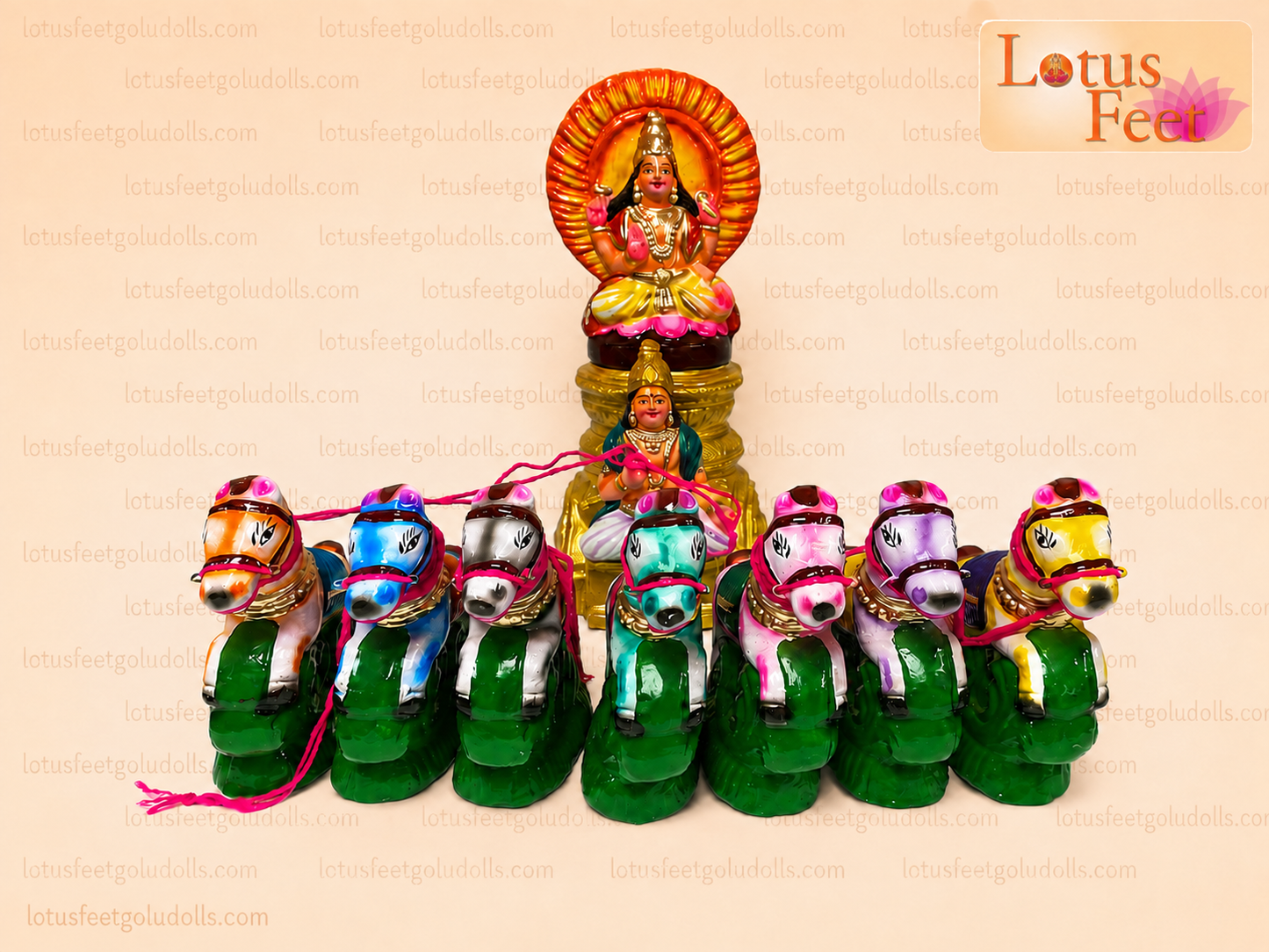
Celebrate the radiant presence of Surya Bhagavan with this handcrafted Surya Ratham clay doll set, a striking representation of the Sun God’s celestial journey. Lord Surya is shown seated majestically in a golden chariot, holding lotus flowers in his hands and surrounded by a brilliant halo that reflects his divine light and energy. The chariot is guided by Aruna, the divine charioteer, and drawn by seven vibrant horses.
These seven horses are traditionally associated with the seven colors of sunlight, the seven days of the week, and the seven meters of Sanskrit prosody. Together, they symbolize the continuous movement of time, the illuminating power of knowledge, and the life-sustaining energy of the Sun.
The horses measure approximately 6 inches, the chariot measures about 8 × 6 inches, and the Surya figure stands around 5 inches. Rich colors, expressive detailing, and traditional ornamentation make this clay set ideal for Navaratri Golu, temple-inspired arrangements, Mahabharata scenes, mythology-themed displays, and devotional collections. The Surya Ratham represents light, strength, discipline, cosmic order, spiritual awakening, and the steady passage of time.
Did You Know? - Aruna, the Divine Charioteer
In Hindu tradition, Aruna is the personification of the reddish glow that appears in the sky immediately before sunrise. His name means “red,” “ruddy,” or “tawny,” reflecting the warm color of the dawn sky, known as Arunodaya. As the divine charioteer of Surya, the Sun God, Aruna sits directly in front of him and guides the seven celestial horses across the heavens.
Aruna is also believed to perform an important cosmic role. By positioning himself before Surya, he softens and filters the Sun’s overwhelming heat and brilliance before its rays reach the Earth. His presence represents the gentle light of dawn that prepares the world for the full radiance of the rising Sun.
According to the Mahabharata, Aruna was born to Sage Kashyapa and his wife Vinata. Vinata became anxious because the many eggs of her co-wife Kadru had already hatched, while her own two eggs remained unopened. Overcome by impatience, she prematurely broke open one of her eggs. Because the child had not completed his development, Aruna emerged fully formed only from the waist upward.
Aruna warned his mother that her impatience would eventually lead to her servitude under Kadru. However, he also foretold that the child born from her second egg would grow into a powerful being who would rescue her. That second son was Garuda, the mighty eagle and divine vehicle of Lord Vishnu, making Aruna the elder brother of Garuda.
Aruna is also remembered as the father of Jatayu and Sampati, the heroic bird figures who play important roles in the Ramayana. Jatayu courageously attempted to rescue Sita from Ravana, while Sampati later helped Rama’s companions by revealing the direction in which Sita had been taken.
Through his sons, Jatayu and Sampati, Aruna’s lineage connects with the broader web of sacred history shared between the Ramayana and the Mahabharata. In temple sculptures and traditional Indian artwork, Aruna may be depicted with wings or shown only from the torso upward, reflecting the story of his premature birth, while guiding Surya’s magnificent seven-horse chariot.
Did You Know? - Surya’s Seven Horses
Surya’s seven horses are interpreted in several meaningful ways. They may represent the seven colors of sunlight, the seven days of the week, or the seven meters of Sanskrit poetry. Aruna, the divine charioteer, represents the reddish glow of dawn that appears before sunrise and announces the arrival of Surya’s radiant light.
Free Shipping